Commercial Roofing Questions in Hammond
Straight Answers On Systems, Cost, Weather, And Permits
These are the commercial roofing questions in Hammond that owners and facility managers bring up most, grouped by topic.
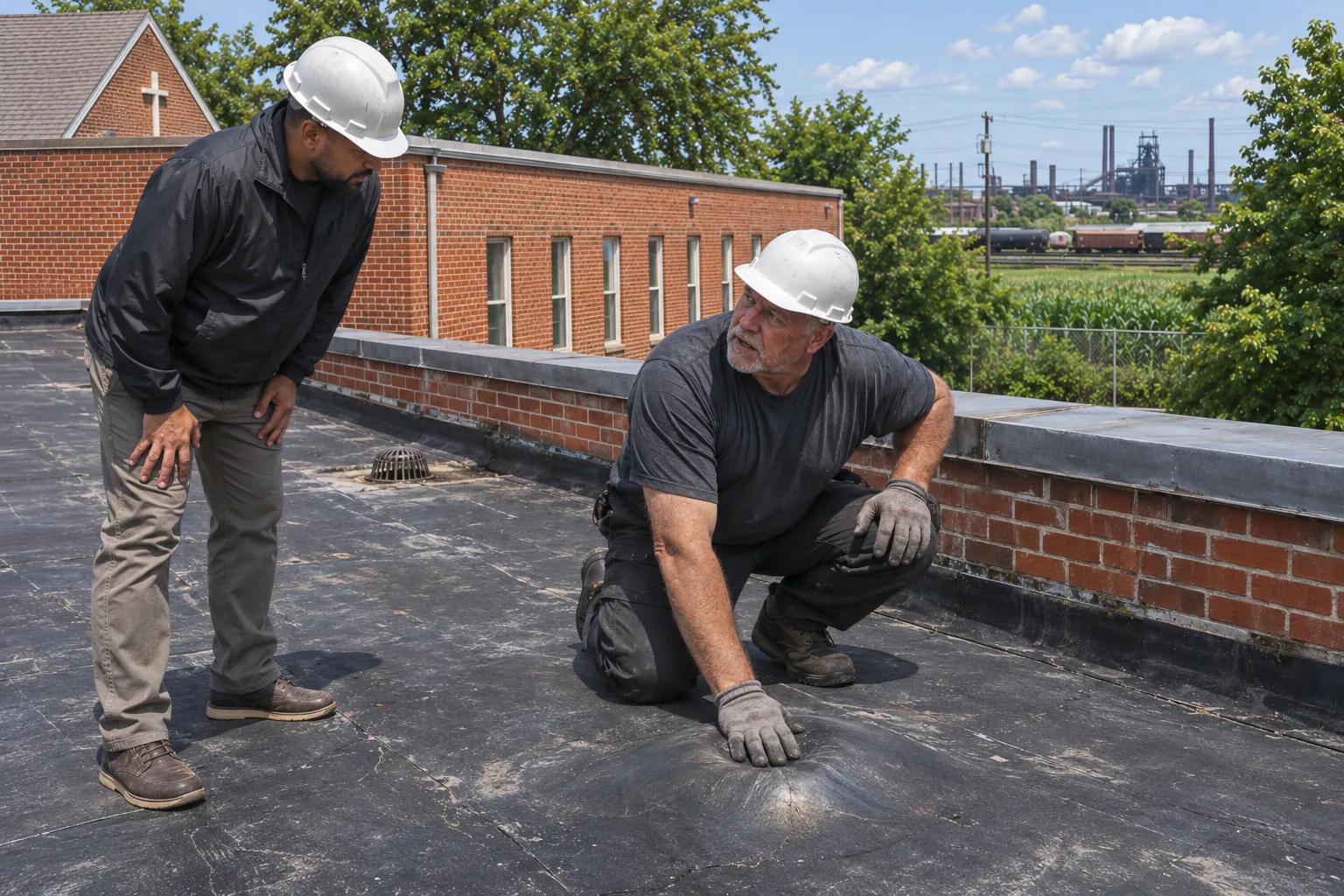
Every answer below covers commercial roofing questions in Hammond and the five towns around it, from membrane choice to permits.
FAQ for Hammond Commercial Roofing, serving commercial buildings in Hammond, Gary, East Chicago, Munster, Highland, and Dyer, Indiana.
Commercial Roofing Questions In Hammond By System
Commercial Roofing in Hammond
- What is considered commercial roofing on a Hammond property?
Commercial roofing covers the roof systems used on non-residential buildings: warehouses, plants, offices, retail centers, churches, and multi-tenant properties.
In Hammond, that usually means low-slope single-ply membranes such as TPO and EPDM, plus metal roofs on industrial and storage buildings. These systems differ from house roofing in slope, size, drainage design, and how they handle rooftop equipment.
- Can a commercial roof be replaced in winter in Hammond?
Yes, with limits. Mechanically attached TPO and EPDM and many metal roof systems can go on in cold weather, while some adhesives and sealants need warmer temperatures.
In a Hammond winter, we tear off only what can be closed up before the crew leaves, clear snow and ice from the deck first, and use products rated for the temperature.
- How do I choose among commercial roofing companies near Hammond?
Ask for proof of insurance, confirm the roofer is registered with the City of Hammond, and request a written scope that names the roof system, insulation, tear-off, and flashing details.
Ask whether the installer is approved by the membrane manufacturer, since many system warranties require it. Compare proposals line by line rather than by total price alone.
- What commercial roofing systems suit Hammond steel mill support buildings?
Steel mill support buildings in Hammond often have large metal or low-slope roofs exposed to dust, heat, and vibration. Heavy-gauge metal roofing and thicker single-ply membranes such as 60- or 80-mil TPO or EPDM hold up to those conditions. We also plan walkway pads, flashing at exhaust stacks, and drainage that keeps residue from collecting.
TPO Roofing
- Can TPO roofing be installed over an existing roof in Hammond?
Often, yes. A TPO roof can go over one existing roof layer if the deck is sound and the old insulation is dry.
We run a moisture survey or take core cuts first, because wet insulation trapped under new TPO causes problems later. A roof with several old layers, a damaged deck, or widespread wet insulation needs a tear-off instead.
- Is TPO roofing a good choice for cold Hammond winters?
TPO performs in cold climates when it is installed correctly. Its heat-welded seams stay sealed through freeze-thaw cycles, and the membrane stays flexible at low temperatures. In Hammond, installation timing matters more than the material: adhesives have temperature limits, and we weld seams only on a clean, dry, frost-free surface.
- Can a TPO roof last 30 years in Hammond?
A TPO roof often lasts 20 to 30 years, and reaching the upper end depends on membrane thickness, installation quality, drainage, and maintenance. Thicker 60- or 80-mil TPO, well-welded seams, and roofs that drain fully tend to last longer. Heavy foot traffic, ponding water, and skipped inspections shorten service life on Hammond roofs.
- What are the downsides of TPO roofing for Hammond buildings?
TPO can be punctured by dropped tools and heavy foot traffic, so busy rooftops need walkway pads. Formulas vary between manufacturers, and older thin membranes have shown early wear. Seam quality depends on the installer's welding, so a careless crew causes leaks. On Hammond roofs, we probe every seam after welding to catch weak spots.
- Why is TPO common on Hammond rail-served warehouses?
TPO's white surface reflects sunlight, and its heat-welded seams handle the large, flat roofs found on rail-served warehouses in Hammond. The membrane comes in wide rolls, which means fewer seams across a big roof.
It can be mechanically attached for speed or fully adhered for wind resistance, and it is repaired easily if a section is damaged.
EPDM Roofing
- How are EPDM seams repaired on a Hammond commercial roof?
EPDM seams that have opened are cleaned, primed, and resealed with seam tape, then covered with a cover strip where the seam has failed along a length.
Old adhesive seams often pull apart after years of freeze-thaw movement. On Hammond roofs, we check every seam once one fails, because seams of the same age tend to fail together.
- How do freeze-thaw cycles affect EPDM roofs in Hammond?
EPDM rubber stays flexible in the cold, so the membrane itself handles freeze-thaw cycles well. The weak points are seams, flashing, and penetrations, where water can enter, freeze, and pry joints open. On Hammond EPDM roofs, we check seam edges, pipe boots, and perimeter flashing after winter, when this kind of damage shows up.
- What is the average lifespan of an EPDM roof in Hammond?
EPDM roofs often last 20 to 30 years, depending on membrane thickness, how the roof is attached, drainage, and maintenance. Seams and flashing usually need attention before the membrane itself wears out. On Hammond buildings, roofs with good drainage, protected walkways, and regular seam checks tend to reach the longer end of that range.
- What are common problems with EPDM roofs on Hammond church halls?
The most common EPDM problems are seam separation, shrinkage that pulls flashing away from walls, punctures, and leaks at pipe boots and vents.
Church halls in Hammond often have large flat sections over meeting rooms, where a small seam leak can spread before anyone notices. We inspect seams, perimeter flashing, and drains and repair what has failed.
Industrial Roofing
- What roofing works best for manufacturing plants in Hammond?
Manufacturing plants in Hammond need roofs that handle heat, vibration, rooftop equipment, and frequent service traffic. Thicker TPO or EPDM membranes, metal roofing on large spans, and reinforced flashing at stacks and curbs are common choices.
We match the system to what the plant does, including exhaust residue, heat output, and how much equipment sits on the roof.
- Why do industrial roofs in Hammond need walkway pads?
Walkway pads protect the membrane along the paths that technicians use to reach rooftop units, fans, and stacks. Without them, foot traffic, dropped tools, and equipment carts wear through the roof surface.
On Hammond industrial roofs, we lay pads from the roof access point to each piece of equipment, welded or adhered to match the membrane.
- What industrial roofing materials are used on Hammond plants?
Common industrial roofing materials include TPO, EPDM, and metal panel systems, laid over insulation board and a cover board where foot traffic is heavy. The choice depends on roof size, slope, chemical exposure, and heat from processes below. For Hammond plants with oil or chemical exhaust, we check the membrane's resistance before choosing a system.
- How is roofing handled around rooftop equipment on Hammond industrial buildings?
Every curb, duct, pipe, and support on the roof needs its own flashing, and those spots are where most industrial roof leaks start.
We flash curbs with membrane carried up the sides, seal pipe penetrations with boots, and set equipment supports on pads. On Hammond industrial roofs, we coordinate with mechanical contractors when units must be lifted during roofing.
Commercial Metal Roofing
- How does snow load affect commercial metal roofs in Hammond?
Snow adds weight that the roof framing must carry, and drifts pile up against parapets, walls, and higher roof sections. Metal roofs also shed snow suddenly, which can damage gutters and lower roofs.
On Hammond buildings, we check design loads with the building's engineer or plans, and add snow guards where sliding snow could hit people, vehicles, or equipment.
- What is metal roof retrofit framing on a Hammond commercial building?
Retrofit framing is a light-gauge steel subframe installed over an existing roof so a new metal roof can go on top without a full tear-off.
It can add slope to a flat roof, improving drainage, and leaves room for added insulation. On Hammond commercial buildings, an engineer confirms the structure can carry the added framing and panels.
- What are the biggest problems with commercial metal roofs in Hammond?
The most common metal roof problems are loose or leaking fasteners, open seams and laps, rust at panel edges, and failed flashing at walls and penetrations. Thermal movement and freeze-thaw cycles in Hammond work fasteners loose over time. We repair or replace the failed parts, and when panels are badly rusted, we replace them.
- Should a Hammond building use standing seam or exposed-fastener metal roofing?
Standing seam panels hide their fasteners under raised seams, so they leak less and allow the panels to move with temperature changes.
Exposed-fastener panels cost less to install but rely on rubber-washered screws that need checking and replacing over time. For Hammond buildings that need long service with little upkeep, standing seam is usually the better fit.
Question About Your Own Roof?
Call and describe the building. A roofer will answer it with your building in mind.
Cost, Weather, Permits, And Towns
Cost and Lifespan
- What drives commercial roofing cost per square foot in Hammond?
Commercial roofing cost depends on the roof system, membrane thickness, insulation needed, tear-off of old layers, roof size, number of penetrations, and access. Wet insulation, deck repairs, and flashing around equipment add to the price. We give a free on-site estimate for Hammond buildings, because roof conditions set the final number.
- How do TPO and EPDM compare for a Hammond commercial roof?
TPO is white and reflective with heat-welded seams, while EPDM is a black rubber membrane with taped seams that stays flexible in the cold.
TPO suits roofs where cooling matters and seams take heavy wear. EPDM suits roofs where flexibility and simple repairs matter. On Hammond buildings, drainage, traffic, and the existing roof often decide the choice.
Weather, Codes, and Permits in Hammond
- How does lake-effect snow affect commercial roofs in Hammond?
Lake-effect snow off Lake Michigan can bring heavy snow bands to northwest Indiana, piling weight on Hammond roofs and creating long melt periods. Drifts form against parapets and walls, and meltwater refreezes at drains and edges. We design flashing heights, drain placement, and tapered insulation so snowmelt has a clear path off the roof.
- What happens to a Hammond flat roof when spring hail hits?
Hail can bruise insulation under a membrane, crack aging seams, and puncture thinner single-ply roofs. Damage is not always visible from the ground. After a Hammond hailstorm, we walk the roof, check seams and flashing, and look for soft spots that point to crushed insulation. Photos and notes help if an insurance claim follows.
- How does summer heat affect commercial roofs in Hammond?
Summer sun heats dark roofs well above the air temperature, which ages membranes, dries out sealants, and drives expansion at seams and flashing. Reflective white membranes such as TPO keep the roof surface cooler. On Hammond buildings with heavy cooling loads, a reflective roof and added insulation reduce the heat passing into the space below.
- Do I need a permit for commercial roofing work in Hammond?
Check with the City of Hammond Building Division, which issues building permits, inspects construction work, and requires contractors working in the city to register.
Commercial buildings in Indiana are governed by the Indiana Building Code (675 IAC 13), adopted by the Indiana Fire Prevention and Building Safety Commission. Permit needs depend on the scope of the roofing work, so confirm them before work begins.
Service Area Towns
- Do you install commercial roofs in Gary?
Yes, we install TPO, EPDM, industrial, and metal roofs on commercial buildings in Gary. Many Gary properties are large industrial and warehouse buildings, so we plan the work in sections that keep operations running. Each project starts with a roof inspection and moisture check so the new system goes on a dry, sound deck.
- Can you replace the roof on an East Chicago industrial plant?
Yes. We replace roofs on industrial plants and commercial buildings in East Chicago, using TPO, EPDM, or metal depending on the building. Plants with heavy rooftop equipment need flashing and walkway planning, and process exhaust can affect which membrane fits. We stage tear-off so each section is closed up before the crew leaves.
- Do you handle commercial roofing for Munster offices and retail buildings?
Yes, we serve offices, retail buildings, and medical and professional buildings in Munster. Many have low-slope roofs suited to TPO or EPDM, with rooftop units that need careful flashing. We plan noisy tear-off work around business hours where possible and keep the building closed in at the end of each workday.
- Is commercial roof replacement available for Highland businesses?
Yes. We handle commercial roof replacement and new roof systems for businesses in Highland, from strip retail to warehouses. We inspect the existing roof, check for wet insulation, and recommend TPO, EPDM, or metal based on slope, drainage, and use. Tear-off and installation are scheduled to limit disruption for tenants.
- Do you install metal and single-ply roofs on Dyer commercial buildings?
Yes, we install metal roofing and TPO or EPDM membranes on commercial buildings in Dyer. Metal works well on shops and storage buildings with pitched roofs, while single-ply membranes suit flat roofs on offices and retail. Each Dyer project begins with an inspection of the deck, drainage, and flashing.
More Commercial Roofing Questions In Hammond?
Call us or ask for a free estimate, and a roofer will walk the roof with you.